

Greater Cincinnati / Northern Kentucky
The water heater that heats with air.
Heat pump water heaters are 2–3× more efficient than standard electric tanks. Request a free estimate and get a clear, written price for your home.
- 2–3×
- more efficient*
- 50–80
- gallon sizes
- 30 sec
- to request
*vs. conventional electric resistance, U.S. DOE Energy Saver. Photo: Roebling Suspension Bridge, Derek Jensen (public domain).
Free installation estimate
Get a price for your house
The process
From request to hot water
A straightforward path with no pressure at any point. You decide if and when to go ahead.
- 1
Request
About 30 secondsShare your name, phone, email and ZIP. A photo of your current tank helps, but is optional.
- 2
Home assessment
Usually within a few daysA Cincinnati-area specialist reviews your space, electrical service and drainage, by phone or on site.
- 3
Written estimate
No obligationA quote built for your house: equipment, labor, any electrical or plumbing work, and incentives that may apply.
- 4
Installation
Typically one dayIf you go ahead, the old tank is removed and the new unit is installed and set up for your household.
Start where you are
The technology
It moves heat. It doesn’t make it.
The same principle as your refrigerator, run in reverse. Most models are hybrids, with standard electric elements for heavy-demand days.
Air
A fan pulls warm room air across a cold evaporator coil.
Absorb
Refrigerant in the coil soaks up that heat and turns to vapor.
Compress
The compressor squeezes the vapor, sharply raising its temperature.
Heat
A condenser wrapped around the tank passes that heat into the water.
Is your home a good candidate?
Four things decide most installations
- Space & air
- Height, clearances, and enough surrounding air — or louvers/ducting where the manual allows.
- Temperature
- The room the unit sits in. Cold garages push it toward electric backup.
- Power
- Often a dedicated 240V circuit. Some newer models run on 120V.
- Drainage
- It makes condensate. A floor drain or a condensate pump is needed.
Not sure about your space? You don’t need to be.
All four are checked during your estimate. If you’re curious first, the optional fit check takes under a minute.
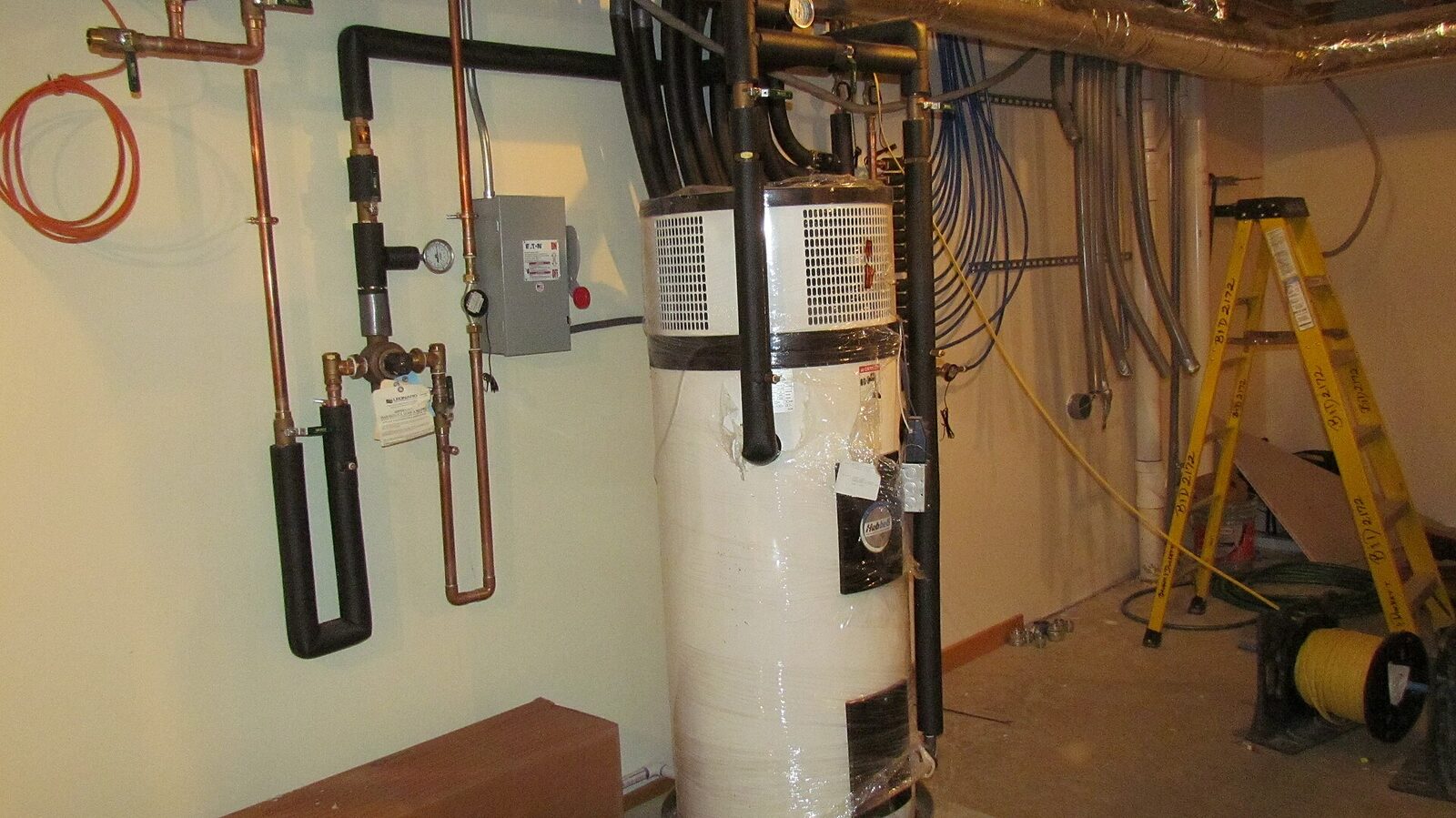
Anatomy of a hybrid unit
Taller than most tanks, with its working parts on top
- 1The fan, coil and compressor sit above the tank and need clearance overhead.
- 2Controls let you choose efficiency, hybrid or electric-only modes.
- 3Cold supply and hot outlet connect at the top; condensate runs to a drain.
Cost
The house sets the price more than the heater
We don’t publish a “Cincinnati average.” These are the line items that actually move a quote.
Equipment
Model, tank size, 240V or 120V
Conversion
Gas capping and vent review, if leaving gas
Electrical
None, a new circuit, or panel work
Plumbing
Connections, valves, expansion tank
Condensate
Floor drain or a pump
Access & removal
Stairs, finished spaces, disposal, permits
Ready for a clear price?
Let’s start with your home.
Request your installation estimate here. Details and a photo are optional.

Clifton
A century-old basement is often the best place in the house for a heat pump water heater.
Bishop Street · Photo: Warren LeMay (CC0)
Compare
How it stacks up against what you have now
| Consideration | Heat pump (hybrid) | Electric tank | Gas tank | Tankless |
|---|---|---|---|---|
| Energy use | Lowest of the electric options | Highest electricity per gallon | Burns gas; varies by model | No standby loss; varies by fuel |
| Upfront | Higher | Lowest | Moderate | Often higher, plus gas/vent work |
| Install | Space, air, drain, power | Simplest | Venting and gas line | Gas sizing or very large circuits |
| Recovery | Slower; hybrid mode assists | Moderate | Fast | Continuous, limited by flow |
| Living with it | Fan hum; cools & dries room | Silent | Combustion and flue | Descaling in hard water |


Local housing
Built for Cincinnati’s older homes
Full basements are an advantage here. Older panels, shared chimneys and tight stairs are the usual hurdles.
- Italianate rowhouses
- Deep basements; narrow stairs to plan around.
- Hillside frame houses
- Walk-out basements; check drainage on the low side.
- Foursquares
- Roomy basements; panels often due for review.
- Postwar ranches
- Utility rooms or garages; room temperature matters.
Guides
Read before you decide


- InstallationDo Heat Pump Water Heaters Need a 240V Circuit?
- InstallationHeat Pump Water Heater Noise: What Homeowners Should Expect
- InstallationHeat Pump Water Heater Condensate: Where Does the Water Go?
Photos: Warren LeMay (CC0); NIST (public domain).
Questions
What homeowners ask us most
Basements, winter, wiring, noise, drainage, sizing and cost.
Can a heat pump water heater go in a Cincinnati basement?
How does it perform in winter?
Do I need a 240V circuit?
How loud is it?
Where does the condensate go?
What size tank do I need?
How much does installation cost?
Are there rebates available?
Do you install the equipment yourselves?

Installation estimate
Get a number for your house, not an average
Four fields, about 30 seconds. A written price for your home. No obligation.
Installation services are performed by independent service providers. Contractor availability varies by location.